BHUTAN: Located
between China and India, the kingdom measures 110 miles from north
to south and 200 miles from east to west. The country is all mountainous
with the exception of the southernmost end which is a continuation
of the plains of northern India. Bhutan's population is around
750,000. The government is a monarchy and the king, Jigme Singye
Wangchuk, makes himself accessible to all of his subjects and is
well liked. The official language is Dzongkha, but English is taught
in the schools. The religion, Drukpa Kagyu, a form of Tantric Buddhism,
regulates all aspects of life. Bhutan's economy is agricultural
and the majority of people live in small rural villages. The Bhutanese
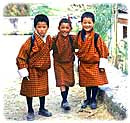
dress in their ancient traditional styles, the men wearing the
gho, a long robe tied around the waist, and the women the kira,
an ankle length dress made of colorful finely woven fabrics.
DZONG: The word “Dzong” loosely translated means
a fortress. For over three hundred years these formidable looking
castles, built mostly on mountain spurs overlooking valleys, have
served as a defense against attack or invasion. The dzongs house
monasteries and also serve as government administrative centers.
GURU RIMPOCHE: Guru Rimpoche (“Precious
Master”) is one of the most important religious figures in
Bhutan. He was a Tibetan lama who arrived in Bhutan in the Seventh
Century and introduced Tantric Buddhism to the country. He is credited
with many magical feats.
PARO: Located in the Paro Valley in
western Bhutan, Paro is the location of the country's only international
airport. In the 19th Century, Paro was the seat of government and
the commercial center of the country. Many important religious
and historical sites are located in Paro.
THIMPHU: The capital city of Bhutan,
Thimphu lies in a wooded valley along the banks of the Thimpu Chhu
(river). This tiny capital city has a population of only 40,000
people and is probably the only world capital with no traffic lights.
WANGDUE PHODRANG: Founded in 1638,
the Wangdue Phodrang Dzong stands on a ridge which commands a view
of two river valleys. Zhabdrung, the religious leader who unified
the country in the 17th Century, was told by a diety that he could
bring the whole country under his rule if he built a dzong on this
ridge, which has the shape of a sleeping elephant. He built the
dzong and named it Wangduephodrang, “wangdue”
meaning “to bring under one's power.”
PUNAKHA: The Punakha Dzong lies at
the junction of the Phochhu and Mochhu rivers. Built in 1637, the
dzong played an important role in the country's history. It was
here that the hereditary monarchy was established on December 17,
1907, when Sir Ugyen Wangchuck became the first monarch. Today
the dzong is the winter residence of the Je Khenpo, the chief abbot
of Bhutan.
BUMTHANG: Bumthang is a region in
central Bhutan and is often referred to as the country's cultural
heartland. Monasteries, ancient temples and palaces are found throughout
the countryside.
JAKAR: The major trading center for
the Bumthang region, Jakar is a base for visiting the many sights
of central Bhutan. The site for the Jakar Dzong was chosen when
a white bird rose into the air and and settled on a cliff overlooking
the valley. This was looked upon as being a good omen, and the
Jakar Dzong, “the Dzong of the White Bird,” was constructed
in 1549.
TRONGSA: Trongsa is located in the
center of the country and is surrounded by high mountain passes.
The Trongsa Dzong, the most impressive in the kingdom, is said
to be one of the most magnificent works of traditional Bhutanese
architecture. Its location was chosen because, while meditating,
a member of the ruling family had a vision of a butter lamp burning,
signifying that this was a sacred place.